Why Is UV Resistance So Important with Insect Traps?
If you manufacture or supply sticky insect traps — whether glue boards, glue rolls, or fly catchers — you'll know they need to perform in some of the harshest environments imaginable. But here's something that doesn't get talked about nearly enough: UV degradation is quietly destroying the effectiveness of most pest trap adhesives.
❌ The Problem: UV Light Is Killing Your Adhesive
Sticky pest traps are designed to catch insects by holding them on a pressure-sensitive adhesive surface. Simple enough in principle — but the conditions these traps operate in are anything but simple.
Consider where most insect traps end up:
Greenhouses
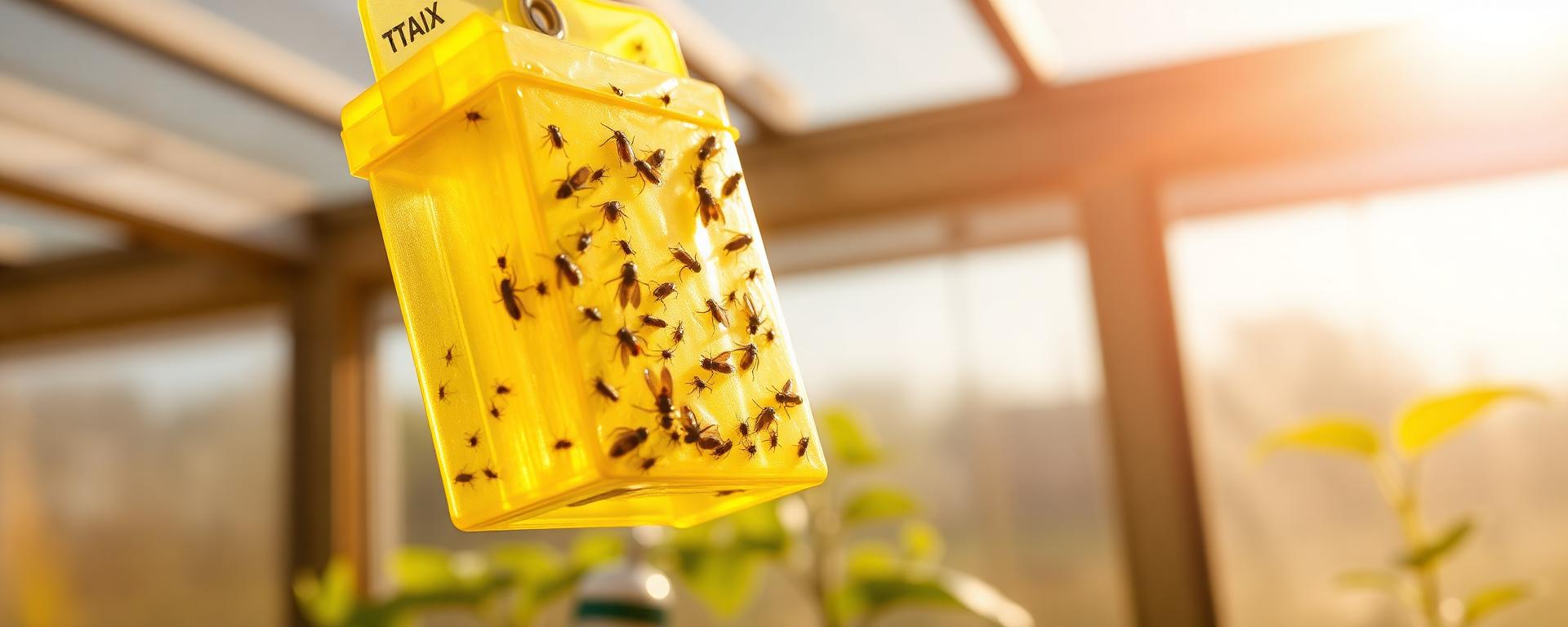
Prolonged direct sunlight streaming through glass panels, sometimes for 12+ hours a day
Food Production Facilities
Positioned in front of UV fly-killer lamps that run 24/7
Outdoor Environments
Exposed to full sun, rain, and temperature swings
Livestock Buildings
Near windows and open doors where sunlight floods in
In every one of these environments, the adhesive on the trap is being bombarded with ultraviolet radiation — and that UV energy is breaking down the polymer chains that give the adhesive its tack. Over hours and days, the adhesive surface that was once sticky enough to catch a fly becomes hard, brittle, and completely ineffective.
The hidden cost
When a trap loses its tack, it doesn't announce it. The board still hangs there, still looks like it's working — but it's catching fewer and fewer pests. By the time you notice, you've been running ineffective traps for days or even weeks. In food production environments, that's a serious audit and compliance risk.
How UV Degrades Adhesive Tack
Pressure-sensitive adhesives (PSAs) used in pest traps are carefully formulated to have a specific level of tackiness — enough to grab and hold a small insect that lands with minimal force. UV radiation disrupts this in several ways:
Chain Scission
UV energy breaks the long polymer chains in the adhesive into shorter fragments. This increases the crosslink density and makes the adhesive harder and less tacky.
Oxidation
UV exposure accelerates the oxidation of the adhesive, forming a hard surface "skin" that blocks the tacky layer beneath from contacting the insect.
Loss of Rheological Balance
The adhesive is designed with a precise balance between being liquid enough for insect legs to penetrate the surface and solid enough to hold them. UV shifts this balance towards hardness, reducing the "wet" feel that makes the trap effective.
✅ The Solution: What We Found Testing 11 Adhesives Under Continuous UV
We recently completed a comprehensive UV resistance study in our laboratory, testing a wide range of insect trap adhesives — including several commonly used grades from across the market. Each adhesive was coated onto PET film at a standardised coat weight (approximately 105 gsm) and placed under continuous UV exposure for 7 days.
Tack was measured at intervals (Day 0, Day 1, Day 3, Day 5, and Day 7) using the Rolling Ball Test — a standard method where a steel ball rolls across the adhesive surface. The shorter the distance the ball travels, the tackier the adhesive. When the ball rolls beyond a certain distance, there's effectively no usable tack left.
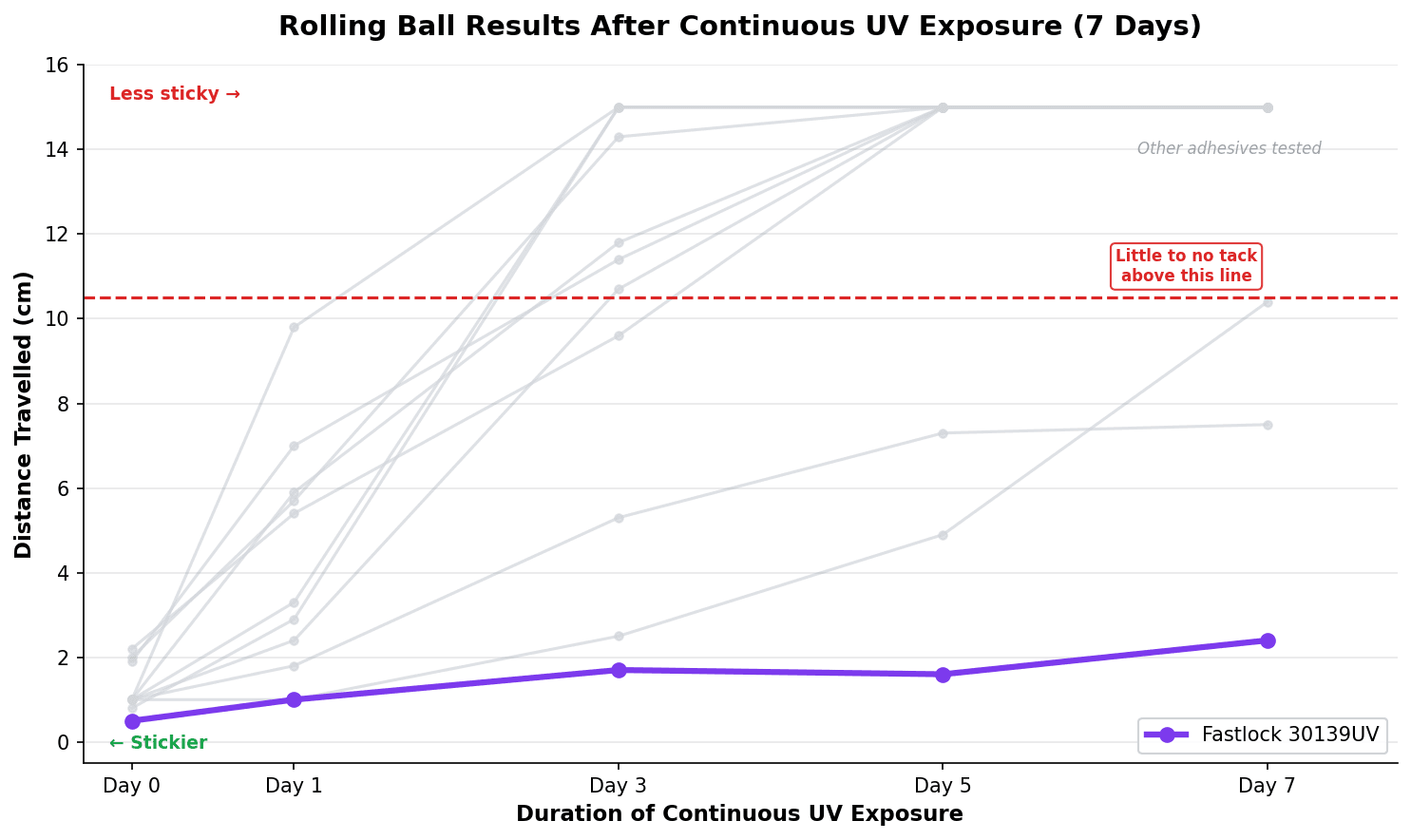
Rolling ball tack test results after continuous UV exposure. Shorter distance = higher tack. The red dashed line indicates the threshold above which there is little to no usable tack remaining. Competitor names have been removed.
The results were striking:
Most adhesives (majority of those tested)
Lost virtually all tack within just 1 day of UV exposure. The ball rolled the full length of the test surface — meaning zero effective catch performance. These adhesives would be useless in front of a UV lamp within 24 hours.
A small number of "UV-rated" adhesives
Survived 3–4 days before tack dropped to ineffective levels. Better than the majority, but still not good enough for traps that need to last weeks in position.
The best-performing adhesive
Still showed excellent tack after 7 full days of continuous UV exposure — losing only around 20% of its original tack. This adhesive was specifically formulated with UV-stabilising technology, and the difference in performance was dramatic.
To put this in context: the adhesive with the worst UV resistance lost all useful tack within hours. The best adhesive retained over 80% of its tack after a full week. That's not a marginal difference — it's the difference between a trap that works and one that's just a piece of decorated card.
What Makes a UV-Resistant Adhesive Different?
Achieving strong UV resistance in a pest trap adhesive isn't as simple as adding a single ingredient. It requires a carefully balanced formulation approach:
- UV absorbers (UVA) — these absorb UV radiation before it can reach and damage the polymer chains, converting it to harmless heat
- Hindered Amine Light Stabilisers (HALS) — these don't block UV but instead scavenge the destructive free radicals that UV generates, preventing chain scission
- Combination approach — our testing showed that using UVA and HALS together provided the best results, as they work through complementary mechanisms
- Base polymer selection — not all adhesive polymers respond equally to UV stabilisation. Some chemistries are inherently more resistant than others
What This Means for Your Traps
If you're manufacturing insect traps that will be used in UV-exposed environments, the adhesive you choose will directly determine how long your product performs. Here are some honest questions worth asking your adhesive supplier:
Questions to ask about UV resistance:
- Has the adhesive been tested under continuous UV exposure? — Not all "UV-resistant" labels are backed by rigorous testing. Ask for rolling ball or loop tack data over multiple days.
- How many days of UV exposure before tack drops below usable levels? — If they can't answer this with data, that's a red flag.
- What UV stabilisation technology is used? — UVA alone? HALS alone? A combination? The answer matters.
- At what coat weight was the testing done? — Results can vary significantly with coat weight. Make sure the testing conditions match your application.
- Can they provide comparative data against other grades? — The best suppliers test against the competition so you don't have to.
Summary
UV degradation is one of the most overlooked factors in pest trap performance. Most adhesives on the market simply aren't formulated to withstand the UV conditions that traps are exposed to in real-world environments. The result is traps that look functional but aren't catching anything.
Our laboratory testing across 11 different adhesives showed a massive spread in UV performance — from complete tack loss within 24 hours to excellent retention after 7 days. If UV resistance matters for your application, it's worth investigating what your adhesive can actually deliver, not just what the label says.
If you'd like to see our UV resistance test data or discuss how our Fastlock® 30139UV adhesive could improve your trap performance, we'd be happy to share the results and talk through the options. No sales pitch — just honest data.
Fastlock® 30139UV
Our UV-resistant insect trap adhesive — the top performer in our 7-day UV exposure test. View the full product details.
View Fastlock 30139UVRelated Reading
For a deeper dive into pest trap adhesive formulation including tack, temperature resistance, and rheology, read our companion article.
The Science Behind Sticky Pest Trap AdhesivesNeed Expert Help?
Developing UV-resistant pest trap adhesives? Our lab team can help with formulation and testing.
Book a Discovery Session