When a hot melt supplier slides a quote across the table, the first thing everyone looks at is the number after the £ sign. It's the easiest figure to compare, the easiest to defend in a procurement meeting, and — almost always — the most misleading number on the page.
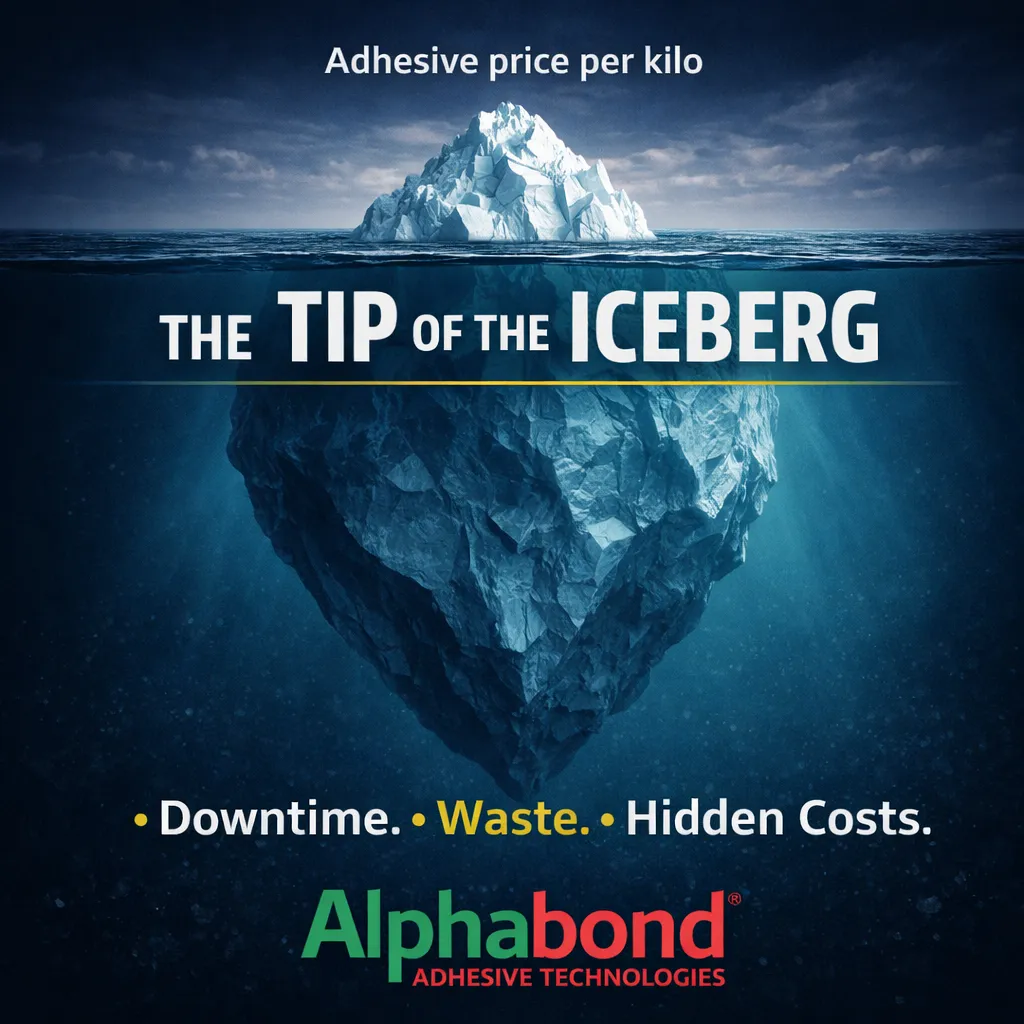
The price per kilo is the part of the iceberg you can see. It feels solid, it feels measurable, and it feels like the whole story. It isn't. Across every site we've assessed in the last decade, the visible cost of the adhesive accounts for somewhere between 30% and 50% of what hot melt actually costs the business. The rest sits below the waterline — in downtime, energy, spares, operator incidents, scrap and customer returns — and most of the time, nobody is measuring it.
This is a guide to seeing the whole iceberg. By the end you'll have a framework, a worked example, and a clear next step for finding out what your real cost per case actually is.
Above the waterline: the price per kilo
Per-kilo pricing is the metric the industry was built on. It's clean, it's quotable, and it slots neatly into a spreadsheet. A typical UK packaging line will see prices ranging from £3.20/kg for entry-level EVA through to £6.50–£10.00/kg for specialist, low-temperature or food-contact adhesives.
That's a 3x to 4x spread. It's no surprise that the cheaper number wins most of the meetings. The problem is that the cheaper adhesive almost never wins on the production floor — and the gap between the two numbers is often the smallest cost difference on the shop floor that day.
The pricing scam variant. Some suppliers quote per litre rather than per kilo, knowing a 20L pail of granulated hot melt only contains around 12.1kg. A £3.80/litre price that looks cheap is actually £6.28/kg. We covered that specific tactic in detail in our Hidden Truth Behind Hot Melt Adhesive Pricing article. This piece picks up where that one leaves off — once you've got a fair like-for-like number, what's still missing?
Below the waterline: the six hidden costs
Six categories sit underneath the price tag. Individually most people can accept they exist; collectively they're usually a multiple of the visible spend. We'll take them in the order they typically hurt a packaging or labelling line.
1. Downtime
Every minute the line is stopped clearing nozzles, swapping tanks or chasing a glue fault is a minute of lost output, lost labour and lost order book. On a single fast packaging line, an hour of downtime can cost £1,500–£3,000 once labour, overhead and missed throughput are added up.
2. Energy
An adhesive that runs at 180°C burns roughly 30% more energy than one that runs at 130°C, before you account for warm-up cycles and standby. Across a 24/5 operation that's tens of thousands of pounds a year per tank — and a corresponding lump of CO₂ on your Scope 1 report.
3. Spares & maintenance
Char-forming adhesives shred filters, block nozzles and bake onto hoses. Every blocked nozzle is an engineer call-out, a part swap and a planned-vs-unplanned maintenance line on the budget. Cleaner-running adhesives quietly extend service intervals by months.
4. Operator incidents & safety
Hot melt at 180°C is a burns risk. So is char that pops out of a melt tank under pressure. Lower-temperature, low-char adhesives reduce near-misses, RIDDOR-reportable incidents and the insurance loading that follows them — costs that rarely make it onto a procurement comparison.
5. Quality failures & scrap
Stringing, pop-opens, label winging, weak bonds and contaminated packs all start as adhesive symptoms and end as scrapped product, rework labour and customer-facing defects. A 1% scrap rate on a £20m line is £200,000 a year — a number that dwarfs almost any per-kilo saving.
6. Customer returns & lost contracts
The most expensive adhesive cost of all is the one that arrives by email from your customer's QA team. A single returned pallet, a complaint credit, or — worst case — a delisting from a major retailer can erase years of per-kilo savings in a single quarter.
A worked example: two adhesives, two very different bills
Numbers always land harder than principles, so here's a worked example based on a typical UK case-sealing line running at 60 cases per minute, two shifts a day, five days a week.
| Cost line | Adhesive A £3.20/kg, standard EVA | Adhesive B £6.50/kg, metallocene |
|---|---|---|
| Annual usage | 12,000 kg | 6,960 kg (42% less, lower coat weight) |
| Adhesive spend | £38,400 | £45,240 |
| Downtime (nozzle blocks, char) | 120 hrs/yr × £1,800 = £216,000 ~480 blockages/yr | 25 hrs/yr × £1,800 = £45,000 ~80 blockages/yr |
| Energy (tank at temperature) | £11,500 (185°C) ~5.2 kW continuous | £5,200 (98°C) ~2.4 kW continuous |
| Spares & filters | £6,800 | £2,100 |
| Scrap / pop-opens / rework | £18,500 | £3,400 |
| Total true cost / yr | £291,200 | £100,940 |
Annual saving with Adhesive B
£190,260
Same line. Same output. Lower true cost.
The "expensive" adhesive is £190,260 cheaper a year on the same line. Per-kilo, Adhesive B looks roughly twice as expensive. In total cost of ownership, it costs around a third of Adhesive A. That's the iceberg in numbers. Want to see where the downtime and energy figures come from? Plug your own line into the Downtime Cost Calculator and the CO₂ & Energy Calculator — both use the same model as this worked example.
Run the numbers for your line
The example above uses typical UK industry figures. To get a number you can take to your finance team, plug your line speed, labour rates and downtime hours into our free calculators — they're built on the same model and take less than two minutes.
When do cheap adhesives win?
The iceberg model assumes a modern nozzle-based hot melt system, where char, blockages and over-application drive most of the hidden cost. If your line has no nozzles — for example adhesive applied by roller coater, slot die, wheel pot or open bath — then blockages and stringing largely disappear from the equation. In those cases a lower-cost adhesive can genuinely be the right commercial choice, provided coat weight, bond strength and temperature stability still meet spec. If you're not sure which camp your line falls into, talk to one of our technical team before you switch.
Why the cheap adhesive almost always wins the meeting (and loses the year)
If the maths is this clear, why do so many sites stay on the cheaper option? Three reasons, and they all come back to who owns which budget.
- Procurement is measured on unit price. The person signing the PO is rewarded for driving down £/kg, not for protecting OEE. Downtime hours and scrap reels live on a different P&L line, often in a different department.
- Hidden costs are hidden by design. Char on a filter doesn't generate an invoice. A nozzle clean doesn't get logged as an adhesive cost — it gets logged as maintenance, or it doesn't get logged at all.
- The change feels risky. "If it ain't broke" is a powerful argument, even when it is, in fact, broke — just broke quietly, in 90-second increments, all year long.
The fix isn't a clever pricing trick. It's a measurement habit. Once a site starts logging downtime causes, energy per tank and scrap by root cause, the iceberg becomes visible — and the conversation stops being about £/kg and starts being about £/case.
Real-world proof: what changes when you move to total cost of ownership
We've run this exercise on lines across the UK. Two of the most quoted examples are worth a read in full:
Finlays — eliminating downtime on a flagship line
How a switch away from char-forming adhesive removed unplanned stoppages and recovered six-figure annual capacity.
Read the case studyTiger Tim — coat weight, scrap and a quieter shop floor
Cutting consumption by over a third without losing bond performance — and what it did to the energy bill.
Read the case studyA simple framework: the five questions to ask before you sign a hot melt PO
You don't need a consultant to start seeing the iceberg. Before you renew your adhesive contract, walk the line with these five questions in your hand.
What is our level of downtime due to blocked nozzles?
Count the stoppages, not just the minutes. Frequent nozzle blocks point to char, thermal degradation or the wrong chemistry — and each one is paid for in lost cases.
What is our true £/case, not £/kg?
Divide annual adhesive spend + downtime cost + energy + scrap by the number of cases produced. The number will surprise you.
How many minutes per shift do we lose to glue?
Nozzle clears, char picks, tank cleans, filter swaps. If nobody knows, that itself is the answer.
What temperature is the tank actually running at?
Then ask whether the adhesive needs to be there. A 50°C drop is roughly a 30% energy cut on that tank.
When did we last benchmark a like-for-like alternative?
If the answer is 'years ago' or 'never', the market has moved on without you.
The bottom line
Adhesive isn't expensive. Bad adhesive is expensive — it just hides the bill in other departments. The price per kilo is the part of the iceberg you can see, and it's the part that matters least.
The sites that win on cost are the ones that measure the whole iceberg: downtime, energy, spares, scrap, safety and the customer-facing fallout of a quality failure. When you measure that way, the "expensive" pellet almost always turns out to be the cheap one.
See your own iceberg.
See how the costs stack up for your factory.
Book a free, no-obligation line assessment. We'll measure your true cost per case — and show you exactly where the hidden spend is hiding.
Draft cornerstone post staged in the playground for review ahead of the hard launch. Not linked from public navigation and excluded from search engines.