
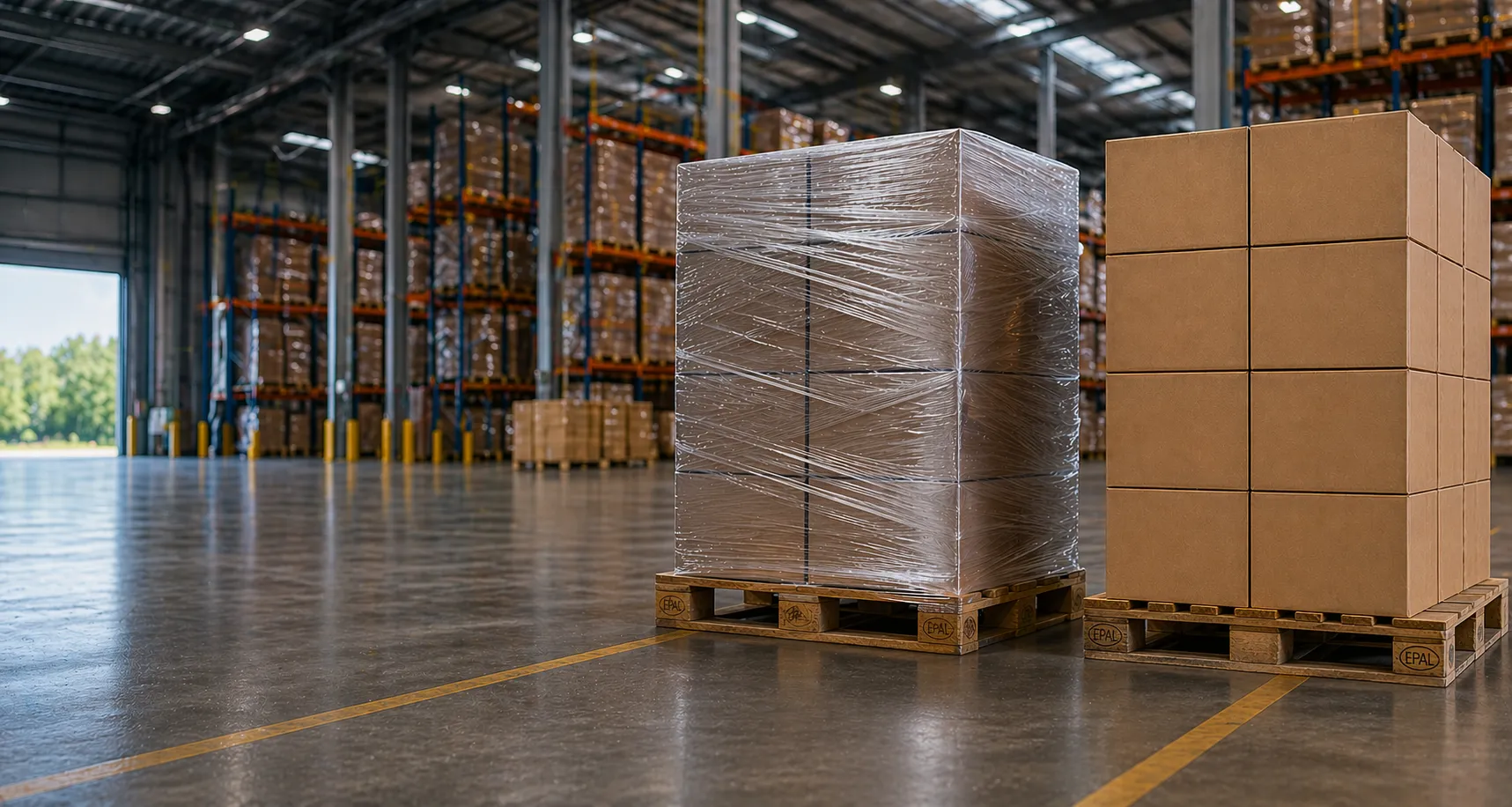
Stretch wrap is the default. It's also one of the largest sources of single-use plastic on a typical UK distribution pallet — and with the Plastic Packaging Tax, EPR fees and the EU PPWR all tightening at the same time, every kilo of film on a pallet is now a line item with a cost attached.
The good news: most of that film isn't doing structural work. It's there to stop layers slipping. Replace that slip with pallet stabilisation adhesive — a tiny dot of clean-peel hot melt between layers — and you can typically cut stretch wrap by 50–70%, sometimes eliminate it entirely.
Why this is suddenly urgent
UK and EU packaging legislation is moving fast and it's all pulling in the same direction:
- Plastic Packaging Tax (UK) — £223.69/tonne on plastic packaging with less than 30% recycled content.
- Extended Producer Responsibility (EPR) — fees now scale with how much packaging you place on the market, and modulate by recyclability.
- EU PPWR — mandatory packaging reduction targets, with explicit calls to eliminate "unnecessary" packaging including grouped transport films.
Every layer of stretch wrap you take off a pallet now reduces tax exposure, EPR fees, scope-3 emissions and the time your operators spend wrapping. It's a rare case where the cheap thing and the right thing are the same thing.
How pallet stabilisation adhesive actually works
A pallet stabilisation adhesive (sometimes called "anti-slip" or "pallet glue") is a low-tack, pressure-sensitive hot melt applied as a small dot or stripe between cases as they're stacked. It gives a high shear strength — so layers don't slide — but a low peel strength, so the cases lift cleanly apart at the other end with no residue, no fibre tear, no print damage.
Other pallet stabilisation systems on the market — for example Lock n Pop™ and similar branded solutions — use the same underlying principle of a high-shear, low-peel bond between cases. The Fastlock® CleanPeel® range is Alphabond's UK-formulated and UK-manufactured equivalent, optimised for the substrates and line speeds most common in British factories.
Tip: hover or tap any image below to enlarge it.
High shear
Holds layers in place through cornering, braking and 1,000 miles of road vibration.
Low peel
Cases separate cleanly at the destination — no torn liners, no scuffed print, no residue on the next pallet.
Recycle-ready
Cases stay in the corrugated waste stream — no contamination, no down-grading of the recyclate.
Paper, plastic, cardboard — one principle, three substrates
The clever bit is that the same adhesive principle works across every common pallet substrate, but the formulation matters. The Fastlock® CleanPeel® range covers the three big use-cases:
| Pallet substrate | Typical product | Recommended grade | Why this grade |
|---|---|---|---|
| Cardboard / corrugated cases | FMCG, food, beverage, e-commerce | CleanPeel® | Balanced shear/peel for printed corrugated — lifts off without fibre tear, keeps the case fully recyclable. |
| Plastic crates & shrink-wrapped trays | Bottles, cans, dairy, personal care | CleanPeel® for plastics | Tuned wet-out on low-energy surfaces (PE/PP shrink) so the dot grips without bleeding or stringing. |
| Paper sacks & paper-wrapped loads | Flour, sugar, ingredients, building materials | CleanPeel® for paper | Lower tack for porous, dusty kraft surfaces — holds the stack but won't tear the sack on de-palletising. |
| Energy-conscious lines | Any cardboard, paper or shrink-wrapped pallet load | CleanPeel® Low Temperature NEW | New low-temperature grade — runs at a significantly lower tank temperature than standard CleanPeel®, cutting energy use, char and operator burn risk without losing bond strength. |
The new CleanPeel® Low Temperature grade runs at a markedly lower tank temperature than a standard pallet stabilisation hot melt. That directly cuts the energy your tanks and hoses draw 24/7, reduces char build-up on nozzles, and lowers the running cost of the system — without any loss of bond performance on the pallet.
The cost & waste comparison
Here's a like-for-like comparison for a typical UK pallet (1.6 m tall, ~32 cases, despatched to a national DC). Numbers are conservative real-world figures from CleanPeel® trials.
| Per pallet | Stretch wrap only | CleanPeel® + reduced wrap | Difference |
|---|---|---|---|
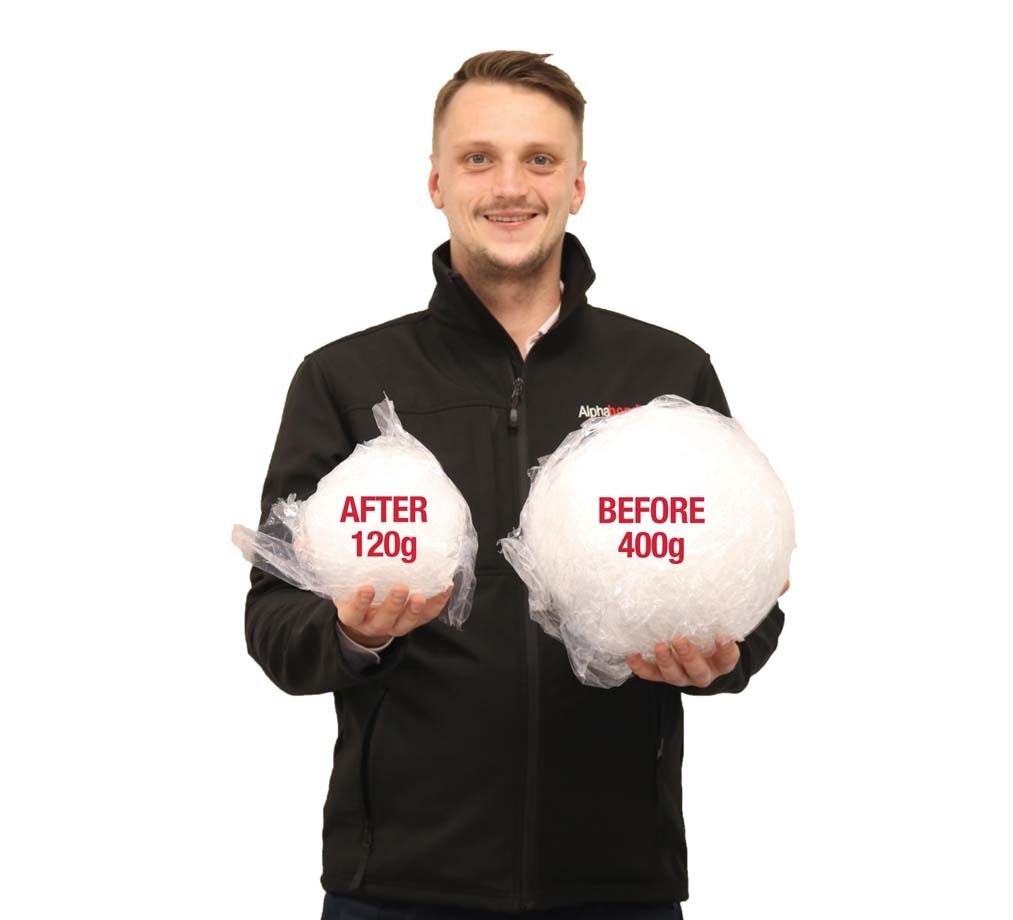
| Stretch film used | ~400 g | ~120 g (one safety wrap) | −70% |
| Adhesive used | 0 g | ~3–5 g | Negligible |
| Wrapping time | ~45 sec | ~12 sec | −73% |
| Material cost | ~£0.88 | ~£0.26 | −£0.62 |
| Plastic Packaging Tax exposure | ~£0.089 | ~£0.027 | −70% |
| CO₂e (film production + EOL) | ~1.00 kg | ~0.30 kg | −0.70 kg |
| Movement in transit (MIT)Lateral case shift on arrival | ~15–25 mm | < 3 mm | ~85% less shift |
| Damage & returnsCrushed cases, fallen layers, write-offs | ~1–3% of pallets | < 0.3% | Up to 90% fewer claims |
The MIT row is the one that quietly pays for the whole switch. Stretch wrap holds a pallet together by compression, so cases still rock, slide and shear against each other every time the trailer brakes or corners. A pallet stabilisation adhesive bonds case-to-case — the load behaves like one block, not 32 individual boxes — so lateral movement in transit typically drops by ~85%. That feeds straight into the cost line most operations care about most: damaged product, scrapped cases, customer returns and the credit notes that follow them. For a typical FMCG line running 100,000 pallets a year, taking damage from 2% to 0.3% is worth tens of thousands of pounds before you've counted a single kilo of recovered film.
Across 100,000 pallets / year
28 tonnes
of one-way plastic
of stretch film removed from the supply chain — plus ~70 tonnes CO₂e and ~£62,000 in direct material savings.
Alternatives to stretch wrap: what actually works?
When buyers search "alternatives to stretch wrap pallet" they usually find a confused mix of options. Here's how they really compare in a fast-moving warehouse:
Pallet stabilisation adhesive
- ✓ 50–70% film reduction (or full elimination)
- ✓ Faster line speeds
- ✓ Cases stay 100% recyclable
- ✓ Works on paper, plastic and cardboard
Recycled-content stretch film
Helps with PPT exposure, but you're still using the same weight of plastic — no waste reduction, no time saving.
Strapping & banding
Good for unitising heavy loads, poor for layer slip. Often used with CleanPeel®, not instead of it.
Reusable pallet covers
Strong sustainability story but reverse-logistics is brutal — only works in closed loops between fixed sites.
"Will the adhesive affect the recyclability of the cardboard?"
No — and this is the single biggest myth that holds buyers back. CleanPeel® is engineered specifically so the adhesive stays on one case at de-palletising. The cases lift apart cleanly, the deposit is minimal and virtually invisible, and the case is fully compatible with UK and EU corrugated recycling streams. We've also published our AquaPeel® water-removable option for operators who want the residue to wash out completely in the recycling pulper.
Where to start
The fastest way to find out what you'd actually save is to walk the line with someone who has done it before. We do free pallet-stabilisation assessments — we'll measure your current film consumption, watch a despatch run, and come back with a substrate-by-substrate plan and a real number for film, time, tax and CO₂.
- Explore the full CleanPeel® product range — paper, plastic, cardboard and the new low-temperature grade.
- See how AquaPeel® handles full water-removable de-palletising.
- Read more on our sustainability & 4-P mission — Productivity, Presentation, Profitability and Planet Friendliness.
Get your free pallet-wrap reduction assessment
A 30-minute walkthrough on your line, a substrate-by-substrate plan and a real number for film, cost and CO₂ saved. No obligation, no sales pitch.
This is a draft Learning Centre post used as a content playground. It is not linked from the public site and is excluded from search engines.