
"Biodegradable" is one of the most attractive words you can put on a product label — and one of the most misused. Across the EU, a whole category of additives that were sold as a route to "biodegradable plastics" — known as oxo-degradable or oxo-biodegradable additives — is now effectively banned. That has direct implications for any adhesive marketed as biodegradable that relies on this chemistry.
What are oxo-bio additives?
Oxo-degradable (sometimes marketed as "oxo-biodegradable") additives are metal-salt compounds blended into conventional plastics such as polyethylene. They accelerate fragmentation when the plastic is exposed to UV light, heat and oxygen. The polymer breaks into smaller and smaller pieces — but it doesn't truly biodegrade in the way compostable materials do. The end result is microplastics.
Why the EU stepped in
Under the EU Single-Use Plastics Directive (Directive (EU) 2019/904), Article 5 prohibits placing on the market products made from oxo-degradable plastic. The European Commission, ECHA and a large body of independent research concluded that:
- Oxo-bio plastics fragment but do not biodegrade in any environment within a meaningful timeframe.
- They contribute directly to microplastic pollution in soil, water and the food chain.
- They contaminate recycling streams when mixed with conventional plastics.
- They are incompatible with industrial composting (EN 13432) and home composting standards.
The practical effect: in the EU, you cannot legitimately sell a single-use plastic product whose "biodegradable" claim is based on oxo-bio additive chemistry.
Banned in the EU
Single-Use Plastics Directive prohibits oxo-degradable plastic products on the EU market.
UK position
UK regulators (Defra, BSI) and major retailers have aligned with the EU view: oxo-bio is not an acceptable route to biodegradability.
What this means for adhesives
A small number of hot melt suppliers in the market have launched adhesives marketed as "biodegradable" that, on closer inspection, owe their claim to oxo-bio additive chemistry rather than genuinely compostable polymers. That matters for any manufacturer using these adhesives in packaging destined for the EU, or for retailers with sustainability commitments that explicitly exclude oxo-degradable materials. A "biodegradable" hot melt that fragments into microplastics is not the same as a certified compostable adhesive.
How to tell if it's an oxo-bio additive
The clearest tell is in the breakdown mechanism. If a "biodegradable" adhesive or plastic only starts to break down when exposed to UV light, heat and oxygen — and there's no mention of microbial activity, moisture, or a composting environment — that is the fingerprint of oxo-degradation, not true biodegradation.
The chemistry behind it is straightforward. Oxo-bio additives are transition metal salts (typically based on iron, manganese or cobalt stearates) blended at low loadings into a conventional polyolefin such as polyethylene or polypropylene. Under UV radiation and elevated temperatures, those metal ions catalyse the oxidation of the polymer backbone — generating free radicals that attack the long carbon chains and chop them into shorter, oxidised fragments (ketones, aldehydes, carboxylic acids). The plastic embrittles, loses tensile strength, and crumbles into ever-smaller pieces.
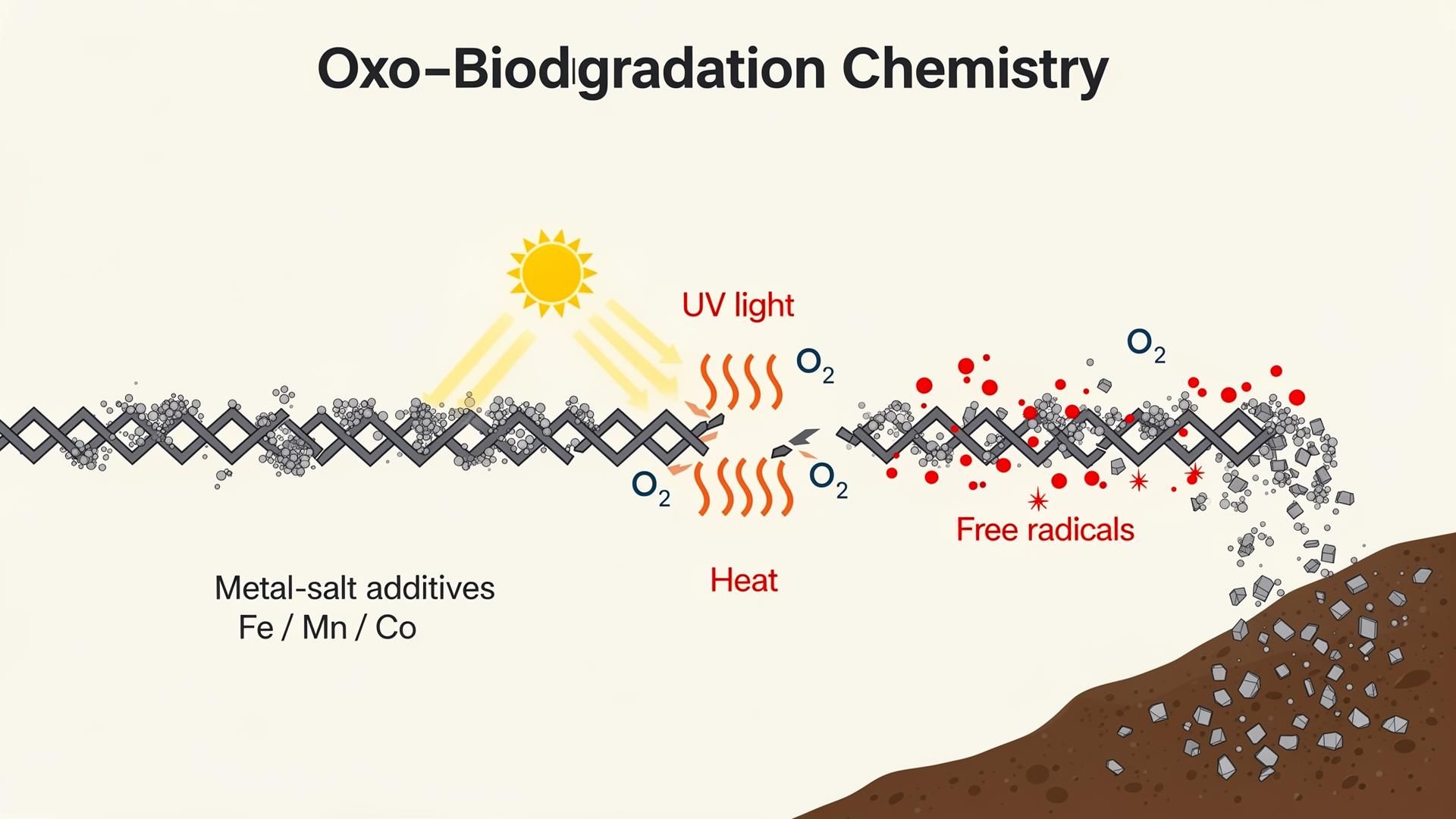
Crucially, that's where the process effectively stops. True biodegradation requires microorganisms to consume the polymer fragments and convert the carbon into CO₂, water and biomass within a defined timeframe and environment (for example, EN 13432 industrial compost or a recognised home-compost standard). Oxo-bio fragments are too hydrophobic and too high in molecular weight for microbes to metabolise meaningfully — so what remains is microplastic, not compost.
A few practical questions flush this out quickly when talking to a supplier:
- Does the product carry EN 13432, OK Compost HOME, or ASTM D6400 certification?
- Is the breakdown driven by microbial activity, or by UV, heat and oxygen exposure?
- Is the base polymer a biopolymer (PLA, PHA, starch-based), or a conventional polyolefin with an additive?
- What percentage of the carbon converts to CO₂ and biomass, and over what timeframe?
The label test
If a "biodegradable" adhesive isn't certified to EN 13432 (industrial compost) or a recognised home-compost standard, ask the supplier directly whether the claim relies on an oxo-bio additive — and whether breakdown needs UV light and heat. If the answer is yes, or the supplier can't say, it is not a safe fit for EU-bound packaging.
What "good" looks like
Genuinely sustainable adhesive options fall into a few credible categories: certified compostable hot melts based on biopolymers, water-based systems with low embodied carbon, and conventional hot melts that drive sustainability through dramatic consumption reduction (less glue per pack, less energy per kilo applied). Each has trade-offs — but none of them depend on a banned additive technology to support the claim.
A balanced view: UK-only supply chains
It's worth being honest about the nuance here. The case against oxo-bio is, in large part, a regulatory one — driven by the EU Single-Use Plastics Directive and aligned UK guidance. If your finished product is sold exclusively within the UK and never enters the EU market, oxo-bio additive technology is not, today, prohibited from your supply chain in the same way. For UK-only manufacturers looking for a low-cost route to a "degradable" claim — and who are comfortable with the microplastic and recycling-stream trade-offs — it can still be a commercially viable option.
The picture changes the moment any of that product crosses into the EU, or lands with a retailer whose sustainability policy explicitly excludes oxo-degradable materials. At that point, oxo-bio stops being a cost-saving and becomes a compliance risk.
A note on legislation
The position set out in this article reflects regulation and published guidance as it stands today. Lobby groups continue to challenge the EU ban, and policy in this area can shift. If you're making a long-term sourcing decision, it's worth re-checking the current legal status before committing — the underlying science around microplastics is unlikely to change, but the rules around what can be marketed as "biodegradable" may.
Where Alphabond stands
Our role is to help glue buyers make informed decisions. For customers supplying into the EU, or working with retailers that exclude oxo-degradable materials, we'd steer firmly away from oxo-bio chemistry. For UK-only supply chains the choice is yours to make with eyes open. Where customers want a genuinely more sustainable bond, we focus on measurable wins: lower coat weights, lower temperatures, less downtime, and — where appropriate — biopolymer or water-based chemistry with verifiable certification.