
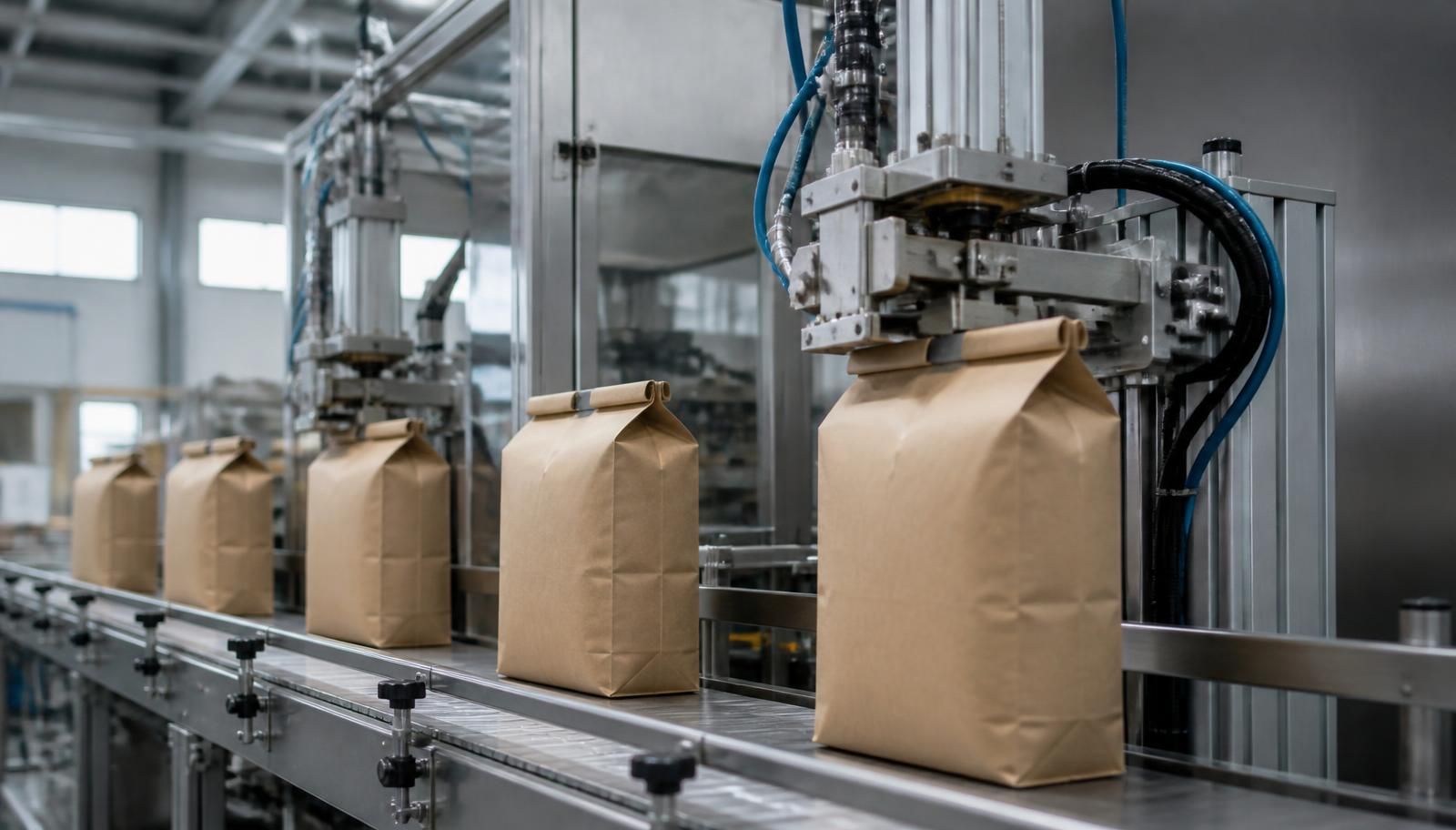
Fastlock® 120 · Fawema bag packing
Running a Fawema? Your Bag Closure Does Not Need 160°C
Fawema bag packers are quick, tidy machines. The adhesive feeding them is usually the oldest thing on the line. Fastlock® 120 closes the same bags from 120°C, cuts glue system energy by 41% and stops the char that blocks your nozzles.
What the machine is actually asking of the glue
On a Fawema bag packer the adhesive has three jobs and very little time to do them. It has to grab a paper surface that already has product dust on it, hold the bag end closed while the pack is still moving, and do it again a hundred times a minute without building anything up on the nozzle or the sealing jaw.
Most lines were set up years ago with a general purpose 160°C grade because that was what existed at the time. The machine has moved on. Fawema controls, servo drives and format changes are all faster than they were. The adhesive is the part nobody revisited.
Why the tank temperature is the real cost
Every hour a tank sits at 160°C is an hour of paying for heat and an hour of slowly cooking the adhesive in it. That is where char comes from. Char is not a product fault and it is not the operator being careless, it is thermal degradation, and the hotter and longer you hold the glue the more of it you get. Blocked nozzles, dark streaks on the bag face and the Friday tank strip all trace back to the same number on the controller.
Fastlock® 120 is formulated to run from 120°C. That is roughly 40°C off a conventional grade, which cuts the energy the glue system draws by 41%. A percentage is easy to nod at, so turn it into money. Drop a 4kg tank from 160°C to 120°C on a line running two shifts and, at current UK industrial electricity rates, the heat you stop paying for is a four figure sum a year on that tank alone. Multiply by the number of tanks in the hall and it stops being a technical detail and starts being a budget line. The tank also stays clear, so the char clean-outs and blocked nozzles come off the maintenance list at the same time.
120°C
Application temperature, straight into your existing tank
41%
Less energy used by the glue system versus a 160°C grade
40°C
Cooler running, which is where the char problem goes away
Put a pound sign on it
Our energy savings calculator takes your tank size, your current and target temperature, your running hours and your electricity rate, and gives you the annual kWh, the annual cost and the CO₂ saved. Two minutes, your numbers, not ours.
Work out your savingSix questions we get asked, answered
Runs from 120°C
Around 40°C cooler than the 160°C grades most Fawema lines still run. Cooler tank, cooler hoses, cooler heads.
41% less energy on the glue system
Measured against a 160°C grade in the same tank. On a line running two shifts, that shows up on the meter inside a month.
No char, no blocked nozzles
Char is a heat problem. Drop the tank 40°C and the degradation that blocks nozzles and streaks bags largely stops happening.
Built for dusty powder lines
Flour, milk powder, starch and sugar dust sit on the paper before the glue lands. Fastlock 120 has the tack to pull through it.
Granulated for autofeed
Free-flowing granules feed cleanly through Nordson, Robatech, Meler, Valco and Preo autofeed systems on your Fawema.
FDA approved
Cleared for food packaging use, with a restricted-substance statement available from our technical team on request.
Dust is the part people underestimate
Flour, milled cereal, milk powder, starch and icing sugar all end up on the outside of the bag before the glue does. A low tack adhesive bonds to the dust layer rather than the paper, which is why bag ends look closed coming off the machine and lift two pallets later in the warehouse. Fastlock® 120 carries high initial tack, so it wets through the surface and reaches fibre.
It fits the glue kit you already own
This is a drop-in change, not a machine project. Fastlock® 120 is supplied granulated so it feeds through the autofeed systems normally found on Fawema installations, including Nordson, Robatech, Meler, Valco, Preo, HHS, Graco and ITW. You drop the tank set point, run the old material out and carry on. No new heads, no new hoses, no downtime beyond a changeover.
Where it earns its place
Fastlock® 120 works across bag closing and side seam on paper and coated paper, and the same grade handles case and carton sealing downstream. Plenty of sites end up running one adhesive from the bag packer to the case sealer, which takes a code out of stores and a decision away from the operator.
What we need to quote it properly
A trial takes one shift and we do the maths with you. Bring these five things to the conversation and we can tell you what the change is worth before anyone orders anything.
- Current tank temperature and set point on the glue unit
- Bag format, paper grade and whether the surface is coated or varnished
- Bags per minute, and where in the cycle the bond has to hold
- Adhesive spend per month, plus how often you strip and clean the tank
- Any recurring faults: bag ends lifting, stringing onto the bag face, blocked nozzles
The honest caveat
Low temperature grades are not a fix for a mechanical fault. If a nozzle is part-blocked, a pattern is out of position or a compression section is set wrong, changing adhesive hides the symptom for a week. We check the machine first and say so if the glue is not the problem.
Download the full article
A branded PDF of the full article, with the numbers, the equipment list and Alphabond contact details on the back. Print it, share it with your engineering and finance teams, or bring it to your next line review.
Book a Fastlock® 120 trial on your Fawema
One day on your line, with your bags and your team watching. We bring the kit, measure the before and after and leave you the report either way.
Book a consultation